Monday, June 17, 2013

You know that feeling when you take a chance on a book and it's really, really great?

...Yeah, that's this one.

(Yes, I realize that updating this blog the day after I talk about not being around much in the future is kind of lame and stupid, but I'm trying to take advantage of the fact that my homework load has not picked up full steam yet)

When I picked up Elisa Schappell's Blueprints for Building Better Girls, it was mostly because I thought that the cover art and title were interesting. 


I don't read short story collections very often; Before Blueprints, I had only read three other short story collections before: 

  1. An F. Scott Fitzgerald short story collection of Flappers and Philosophers and Tales of the Jazz Age (Here)
  2. Firebirds (here)
  3. Different Seasons, by Stephen King (which was awesome, btw)

For that reason, my choosing Schappell's Blueprints was therefore more of a shot in the dark kind of deal, and it was a task that I was kind of wary about undertaking. As I've said before on this blog, I don't read "contemporary" "adult" fiction very often, so I don't have a good understanding yet of what authors I do and don't prefer.

I'm really, really happy to report that I loved this collection. 

To be honest, I read this book a few weeks ago, so I can't remember any passages from it specifically; however, the theme throughout each story was, "you have no idea what is going on in my head."

(God, I feel like that's such a stupid way to summarize the book, but that's all I have. Sorry.)

Different reviewers (from the NY Times and Bitch Magazine) cited the stories as focusing on "womanhood," which is something I should have said above  I agree with; many of the women in Blueprints are often at odds with themselves as well as with each other. Relationships are dissected, scrutinized, and redefined; Heather, "the school slut" in the first story, makes an appearance in the last one as well, as a mother with a teenage son. 

The women in these stories enter each others' lives at various points, and in different ways. I liked that aspect of these stories (I'm a huge fan of "easter eggs" in books), although the sappy part of me wishes that some of the other characters (Kate and Bender specifically) had more of a role to play in other people's stories. Despite that, I really liked being able to take their thoughts and emotions into consideration even if I was reading the story that surrounded one of their friends or coworkers. 

There were times reading this book when I felt outraged on behalf of the characters, as well as times when I was furious at them. Each of these women are shown to struggle and succeed in different ways; there is no "correct" way to deal with the disappointment and sadness and confusion that they felt, but in considering my own expectations for their behavior I was able to more fully understand what had shaped me to think why my way was the "right" one. I'm still trying to figure out where I "fit in" as a feminist, and so this book really helped me examine some parts of myself that I wasn't aware of without being obnoxious or patronizing.  

Does any of that make sense?

What I'm trying to say here is that I really, really liked this book; it's sharp, and smart, and doesn't play the rules in using classic female stereotypes. If you're looking for a book to read that has punch, and wouldn't mind trying out a short story collection, look here - Schappell has just what you need. 


Peace out, Chickadees (as my grandmother would say)
-M

Sunday, June 16, 2013

Update from the Gates of Hell, or: Let's All Do the Charleston! (The Diviners, by Libba Bray)

I'm going to update this blog today, because apparently starting tomorrow, my life will be handed over on a silver platter to Arabic language (which I will be devoting myself to for the next eight weeks). This is, of course, going to be a huge time commitment for me, so updates (and reading) will slow down for the next while.

But before I go down that path, here's what I finished reading (and almost forgot to blog about!):


When I was in middle school, I read as much Libba Bray as I could get my hands on which, at the time, consisted of her Gemma Doyle trilogy. Since then, I've also read Beauty Queens and some of Going Bovine... and while I liked them, they didn't have the same flair as the Gemma Doyle books. 

The Diviners, however, made me squeal with joy. I mean, it's a supernatural book that takes place in 1920s New York City. (Right??? How awesome does that sound?)

The Diviners is about a young woman named Evie who, after a disastrous display of her psychic abilities in her small Ohioan (is that even a word?) hometown, is made to move in with her Uncle Will. Her Uncle Will not only lives in New York City (which is a heaven for this young flapper), but also runs the Museum of the "Creepy Crawlies" (or, of American Folklore, Superstition, and the Occult, if you want to get technical). He is unsuitable to take care of young Evie, but as he is more preoccupied with a serial killer (of the supernatural persuasion) on the loose, Evie (and the reader) is allowed to roam the streets of New York.

There's a wide range of characters in The Diviners, who also encompass some growing social issues and trends from the 1920s; Socialists, African Americans, gays, etc., are all represented. The "melting pot" that is New York (and, on a larger scale, America) is shown to be new and electric, but also dark and unstable. Older, darker forces are establishing a hold on the country despite scientific and social change. 

Obligatory Josephine Baker doing the Charleston. Via

Another totally necessary flapper. Via

While my description of the novel can sound a little limiting, the story is told by several people, so nothing gets too stale. This also means that, with many characters' fates up in the air, the reader is left wanting more and desperate to get back to Evie's New York. The reader is also left with the impression that something is most decidedly wrong, although whatever the cause of the terror and unease is as of yet unknown. 

It was SO SCARY; like, I had to go into the basement where my brother was killing people on the XBox just so I knew that, if Naughty John somehow managed to kill me through the book, someone would know. (I put up with my brother's "I seriously can't believe that we're related, what, are you fucking kidding me" look just so I could finish.) I don't get scared by books often/almost never, so I'm going to just make a special note of that. Well done, Libba Bray *claps*

Bray obviously did her research, with all of the '20s slang that is woven through the novel. It's sometimes cheesy, but she doesn't overdo it, and by using slang, she's able to establish characters such as the flapper girls Evie and Theta more easily. 

I had been struggling with keeping up my reading for a while before reading this book; I wasn't super interested in anything I had gotten from the library, and I was easily distracted from what I was reading while I was reading. I think it was because I had gotten so wrapped up in trying to read books that I felt like I should read, I had forgotten to read something because I wanted to. And I think that's what made The Diviners such a fun, pleasure-filled read for me; no one was expecting anything from me, and there was no expectation I was trying to meet. Does that make sense?

Anyways, I'm back to reading things I want to for a change, and it feels great. All too easily, I feel like I have to be reading something specific at a certain time, and my increased time on the internet (on Goodreads, reading other blogs, etc.) doesn't help my feelings of constant inferiority. I've talked before on here how I so desperately want to be well-read; and, in the process of wanting to be so, I make myself lists of "classic" and "good" books, when I should be the one deciding for myself what's good and what isn't. For someone like me who loathes people telling her what she should and shouldn't be reading (unless it's a friendly reading recommendation, I love those!), I use websites like Goodreads an awful lot to make sure that what I've read will pass muster. 

That's probably enough from me at this point; hopefully y'all haven't died of boredom. Closing statement: read Libba Bray's The Diviners! (but, of course, only if you want to...)

Peace,
-M

Thursday, June 13, 2013

Moving at the Speed of Sound

Just a quick update today. Because I've been "entertaining" this entire past week (and now that they're gone and I should theoretically have some time to myself), I leave TOMORROW for school/camp/whatever (and I need to PACK like a mofo).

I've been trying to read, but between watching lots and lots of the X Files and lots and lots of Saturday Night Live (circa 1993), I haven't devoted much time to it. So, here's a general update to what I've been reading lately:


I have a post or two in the works, so I'll hopefully have them up some time next week.

HAGS,
Maddie

Tuesday, May 28, 2013

I Love... Bite Me!

So, one of the problems in writing a book blog is that it's hard to talk about books I've read in the past; I want this blog to be current and keep it as a sort of diary about the books that I'm reading now and my thoughts on them. So I decided that I wanted to start a new blog feature titled "I Love..." Due to the weird, hectic nature of my summer vacation schedule, I'm still trying to figure out a decent update time. Hopefully once I go back to school, I'll be able to commit to something concrete, but for now it's whenever I can get either the time or the gumption to write.

But enough about that. This post, I want to talk about the magical, fantastical, hilarious and revolutionary webcomic Bite Me! by Dylan Meconis.


Some background about me: I really love comics. 

I'm not one of those people that can name issue numbers and list obscure comic details that only a "real fan" would know (which, really, the entire concept of a "real comics fan" is just bullshit). But I am familiar with certain artists, and I do love and appreciate how some stories that can be told in comics aren't possible in just prose. I am all about visuals, and as someone who personally loves to draw, I love taking in comics pages just so I can look at the artwork. 

But because I didn't have a disposable income as a child, and had (correction: still have) a mother who really would rather have me reading "literature" than comics, I had to find other (read: free) alternatives. Enter, webcomics.

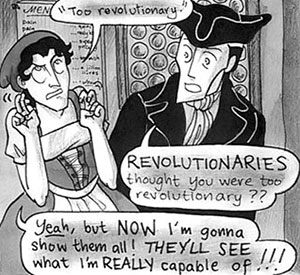
Dylan Meconis's Bite Me! was one of my first discoveries, and it has more than held up over the years. It's about a group of vampires trying to rescue their coven from French revolutionaries. There are tons of jokes about Robespierre, mobs, how to raise a riot, and chickens. (Revolutions are a surprisingly fabulous time and place to make jokes about the ruling class.) Meconis is absolutely hilarious, and the variety of characters means that each one is a screwball in their own right.

Claire. Literally one of my favorite characters ever. Via

The art is absolutely fantastic, and this work (? what else should I call it?) continues to inspire me every time I read it. I'm asking for it for my birthday, but it's all online!

Although Bite Me! is over, the story (kind of) continues in her comic Family Man, with the werewolf Luther Levy. Like Bite Me!, Family Man is fantastic, and I cannot recommend it enough.

Has anyone else read Bite Me! before? Or is anyone else interested in webcomics? List the title in the comments, and I'll give them a try!

Happy reading!
-M

Saturday, May 25, 2013

Eleanor & Park & the 1980s

Not a very creative title, but whatever; it speaks for itself.

A book that I read a few weeks ago that I hadn't been able to post about until now is Eleanor & Park, by Rainbow Rowell. I had only heard about it once before (through the blog of an author I like), and decided to put it on my "to read" list. Lucky for me, a few days after I saw that it was on sale at the Kindle store for less than $3! I snapped it up instantly.


Eleanor & Park is, at its heart, a story about first love and all that it entails. A lot of people, when reviewing this book, notes its ordinariness; how it isn't groundbreaking, or different (in terms of the characters, situation, etc.). Some people criticized the 1986 setting; some people claimed that they could relate the Eleanor and Park, and the Midwestern setting. Some say that while it isn't the story that's new and amazing, but the way that it's told. (I don't exactly agree with that idea, but that could be because I haven't really read YA Fiction in a while.)

I thought that it was kind of brilliant. And not like "yeah, I mean, it was almost brilliant." No. "kinda," as in, "well, goddamn. She's got me pegged."

Too often, when I read YA books about romance and love, it becomes more "adult" than I think authors mean to. And that isn't their fault; but I want to say that Eleanor & Park by Rainbow Rowell has come the closest to captioning what I felt when I fell into like, and then into love. And that, for me, makes it groundbreaking.

I read this book on my Kindle (one of my first, might I add!), and as my boyfriend can attest, I brought this book everywhere with me. Hell, I brought it with me while driving to see Jurassic Park: 3D when with our friends, and they probably thought that I was acting like an antisocial nutcase. But that's OK, because for this book I would do it all again! This book filled me with sympathy, sadness, and dread as much as it filled me with excitement and longing.

I felt like I really connected with the characters; like them, I often experience the frustration that comes with practically being an adult, but still living by someone else's own rules, and feeling restricted in expressing myself as a result. But maybe that's just a trademark of the Midwest? (Kidding. I love the Midwest.) I understand what it's like to come into an insulated community as a newcomer, someone who has "I DON'T BELONG" written in red ink on their foreheads. Making the transition, as Eleanor did, from community to community, is hard because all of a sudden your own rules and standards are invalidated by those around you. I'm not from "the Neighborhood" in Omaha, Nebraska, but my mom did live there for a time when she was going through her own family drama, and her experience sounds very similar to Eleanor. I'm from Kansas City, myself, so while I am not intimately familiar with Nebraskan life, I do feel like the area that I moved to in elementary school (and later high school) is very similar to the one in Eleanor & Park. 

While some people really liked the settling, other reviews I've read criticized the use of the '80s in the novel, claiming that it wasn't "utilized" properly. To that, I say "seriously?" Because here's the thing about teenagers living in any time period: we don't care. We don't care that it's the '40s, '80s, '90s, whatever. We don't stop and think, "You know? I think that America is at an interesting cultural point; considering of course the ongoing Iran-Contra scandal (What was it being called then? Same thing?), the fact that Lady Gaga - oh it's ok if you don't know her yet - has just been born, and all of these other things." Did I lose my point? Let me start again.

Teenagers don't often think of the significance of the time period they were in in the same way that adults do. We think about things generally, sure, but we don't analyze. The fact that Eleanor & Park took place in 1986 but didn't mention at every available opportunity that the time period was 1986 is in itself significant. When John Hughes made Pretty In Pink and Ferris Bueller's Day Off, one could argue that the 1980s weren't really exploited in the way that they are now.

the 1980s, as imagined by youths today. Via 

Did Ferris and Andie and Blane and Duckie and Cameron really think about the "big picture" of the period they were living in? No! They were doing what every other 1980s teenager was doing: ditching school to sing on parade floats and New Wave-ing it out. They were just living life; they were just being teenagers.


Living every 1980s teenager's dream. 

(I'm assuming my point was made. Hopefully the visuals helped.)

I would definitely recommend Eleanor & Park to anyone that's interested in YA fic. And hell, if I found the right adult, I'd probably recommend it to them, too. I think that this novel has a lot of heart and a lot of truth to it. (Also, a lot of comics. It seriously made my little nerd-heart sing.) I felt like I really connected to the characters, and like I really identified with them and their struggles with their bodies, their families, etc. And not to sound totally cliche, but that doesn't happen very much for me anymore. 

I don't want to say that this book will change your life. It will, however, hopefully reaffirm yours. 

-M

Have something to say about Eleanor & Park? Feel free to leave a note in the comments!

Thursday, May 23, 2013

Are You My Mother?


I really, really, really wanted to read Are You My Mother? (by Alison Bechdel) immediately after finishing her "tragicomic" (and other memoir), Fun Home. I put it on hold at the library immediately after I finished, and began my anxiously wait for it to arrive. Although it was probably only like four or five days, it seemed like forever, and (as I mentioned in my last post) I went and picked up more books in the interim. (I was probably seen by the librarians as some weird college kid, who had nothing better to do than search the "Holds" shelf and walk around picking up and putting down books. I was really hoping that it had come in already, and they hadn't had the chance to email me about it.)

Are You My Mother? centers on Bechdel's complex relationship with her mother. It's longer than Fun Home, and is acknoledged by Bechdel to have begun long before her father's story. It's a long, complex narrative involving psychoanalysis, therapy, feminism, and sexuality. And really, that's just the beginning. This book was way harder for me to read than Fun Home - I was able to knock out Fun Home within a few hours, whereas with Mother took me multiple readings of working my way through it, carefully going over the dialogue, trying to digest ideas and theories that are way above me. Not to mention vocabulary that just... went by me. It was like a wind tunnel, and I was trying to grab at ideas in order to make Bechdel's story make sense.

Not to say that Bechdel didn't do a good job with this graphic novel; on the contrary, she composed a perfect companion piece to Fun Home. The fact that her mother is still living, and that their relationship is still unfolding, means that she does not have the luxury of having the years between her father's suicide and her writing the book to reflect and examine him. In any case, both books seem to have taken multiple years to complete. (Maybe a decade in total? I have no idea.)

It's kind of frustrating for me to admit that this book might be more advanced than me; often I found that I was comparing myself to Bechdel while I was reading the book. I compared what we're reading, writing, drawing, listening to... what we're aware of, quite simply. Whether or not she was the same age as me when I was making the comparison is of no consequence. The sad competition still remains; I acknowledge that Bechdel is superior, not only being older than me,  but also more worldly. She has obviously done more than her fair share of research in terms of psychology terms, and such. She mentions how (for a time), all she seemed to do was go to therapy, read about it, and write about it. Her experience serves her well; she knows her stuff, and is probably an expert in her own right.

(I've tried to get that last bit right, and hopefully it came off ok; I just really admire Bechdel, and I want that to come through in this not-quite-a-review.)

While I will probably try to read Mother again at some point in the future (when I feel more prepared, haha), I'm ready to return it to the library. I feel like this book is one where I need distance from it in order to cultivate my appreciation of it (ha!).

Since finishing, I've been researching Bechdel, and was surprised to find out that she is the person behind the Bechdel Test.

For those of you who don't know, the Bechdel Test is a series of criteria used to test gender bias in fiction (usually movies). To pass the test, the work must contain (1) two female characters who (2) talk to each other (3) about something other than a man.


As Sarkeesian states above, it isn't about whether or not a movie is feminist, but merely reveals gender biases in film. Although what this test reveals is a bit frustrating (here is a list of movies that do/don't pass the test*), I still think it's kind of cool that Bechdel is kind of the reason behind it. I'm kind of nerding out about this because I've only recently learned about the Bechdel test, so it's (for me) a way of connecting the "real world" and books. I guess having stuff like that, not-really "coincidences," is something that happens in the real world? Haha I need to get out more. 

(No, really)

Hopefully I will have another piece up before next Thursday, but we'll see! 

-M

*Although admittedly, this list is subjective to the viewer. 

Saturday, May 18, 2013

Another Book Haul! And Thoughts on Reading

I haven't started my summer programs yet, so until then, I have looooong stretches of free time that I need to fill. So what do I do with my free time? Go to the library. And pick up everything pretty.


My latest haul. Seems like I have a problem...

(In my defense, I've been anxiously waiting for my hold on Alison Bechdel's Are You My Mother? to come through.)

Also, I'm almost done with my last batch - I'm currently working through The Lonely Polygamist, but I kind of wanted to have a back-up in the mean time. Or *cough* a lot of backups. I'm worried that I'm not as interested in Polygamist as I should be, and that I'm not really invested in these books like I should. I've actually returned Tolstoy and the Purple Chair, two days after picking it up. I can't put my finger on why, but I just didn't care for it.

Why is that? The idea of reading a book a day is crazy insane, but also really appealing to me. I really wanted to read this book... but why? Because if I read it, I too could read a book every day? Or because I would be living vicariously through the author?

It bothers me that I didn't like Tolstoy like I feel I should have.

But something has been on my mind lately; about reading, and books, and what I'm choosing to read and why. Also, trying to account for my huge surge in reading.

Why am I reading these books, and why so quickly? Am I giving myself the opportunity to really read and understand, or analyze them? Or am I blowing through them like candy, not really taking them in in any meaningful way? My mom was the first one to ask me this, but there's a quote that I've read recently that, for a lack of being able to find it, says that it's better to read one book ten or twenty or an infinite amount of times and have a deep understanding of it and the author than reading a ton of books and have a shallow understanding or knowledge of it.

I worry a lot about whether or not I'm well read for my age. Part of this insecurity is because A) I'm in college, and comparing myself to my friends and not-friends is unavoidable, since I'm a competitive person and pride myself on being smart or well educated; and B)I'm more involved online, and am exposed to more people who are my age and have read more, created more, know more than me. And I don't like that feeling; it's deeply unsettling for me, and while I'm working on nipping it in the bud when I can feel my competitive side rise, it's still an issue.

I want to know things. And I want to understand them. More than that, I want to be able to understand other people when they mention things casually in discussion. It isn't that I hate ignorance; it's just that I don't tolerate it in myself. And lately I've been feeling like I haven't been really getting the full benefit of the books that I'm reading.

Literally my nightmare. Via

So, I guess what I'm trying to say is that I'm going to make an effort to actually read and understand the books that I'm checking out. While I understand that there is literary fluff out there (and I'll gorge myself on it), I want to be able to understand the books I read and why they're important. I want to be able to have a discussion with someone about them, and have it go beyond, "Yeah, I read it. I liked it." (Because WHY did I like it? I've found that I like books a LOT better after I've given them critical thought.)

I'll sign off on that note; stay cool y'all!
-M